

Changmei Technology as a Top Rail Pads Factory: China's first Continuous Polyurethane Foaming Production Line

Elastic Rail Pads Use Thermoplastic Injection as Their Direct Production Route
The direct manufacturing pathway for Elastic Rail Pads relies on the precision injection molding of thermoplastic elastomers, including TPEE, TPU, and TPV. The core objective of this process is to ensure extreme dimensional accuracy and uniform material distribution within each pad. Consequently, the engineering parameters for these specific rail pads must be evaluated distinctly from the company’s separate polyurethane continuous foaming history.
The thermoplastic materials offer targeted engineering options: TPEE (thermoplastic polyester elastomer) provides a highly resilient platform, TPU (thermoplastic polyurethane) delivers exceptional abrasion resistance, and TPV (thermoplastic vulcanizate) expands the operational window for extreme environmental conditions. This material breadth allows engineers to select the exact elastomer required for the track's stiffness, durability, and local climate.
Precision injection molding forces the elastomer into a highly controlled mold cavity, making it the ideal process for manufacturing rail pads and under-baseplate pads that feature fixed geometric profiles, specific locating holes, and complex load-bearing surfaces. This direct molding route guarantees that every pad matches the engineering drawings precisely.
Static Stiffness Separates Rail-Pad and Under-Baseplate Functions
Changmei Technology strictly differentiates its components based on their location within the fastening assembly, setting the static stiffness for rail pads at 30–40 kN/mm, while configuring under-baseplate pads at 55–70 kN/mm. These distinct parameter windows reflect the different functional requirements for elasticity and load distribution at each installation interface.
A rail pad sits directly beneath the steel rail or rail baseplate. Its primary function is to provide controlled elasticity during dynamic wheel-rail impact, absorbing shock while strictly limiting excessive deformation that could compromise gauge accuracy and overall track geometry. The 30–40 kN/mm range strikes the exact balance required for this critical interface.
Conversely, an under-baseplate pad supports a much larger contact area and must bear the redistributed load of the entire fastening node against the concrete sleeper. Therefore, it requires a different static stiffness window (55–70 kN/mm). Procurement professionals must map these target stiffness parameters directly to the specific track design documents, rather than simply requesting a generic "elastic pad."
Dynamic-to-Static Ratio and Fatigue Define Long-Term Elastic Stability
An elastic rail pad must not only achieve its initial static stiffness but also retain its elastic properties under continuous dynamic loading and long-term cycling. Changmei Technology quantifies dynamic amplification and fatigue durability by enforcing a dynamic-to-static (D/S) stiffness ratio of <1.45 alongside a rigorous 3,000,000-cycle fatigue criterion.
A lower dynamic-to-static stiffness ratio is crucial for limiting the excessive increase in stiffness that occurs when the pad is subjected to the dynamic frequencies of passing trains. Keeping the D/S ratio below 1.45 ensures that the vibration mitigation and load distribution performance of the pad remain predictable and consistent under actual operational train speeds.
The 3,000,000-cycle fatigue test enforces a strict "no post-fatigue cracks" standard. This directly links the theoretical durability of the thermoplastic elastomer to observable, real-world failure conditions. By insisting on zero cracks after three million cycles, procurement teams can confidently request test records that prove the pad will maintain long-term stability on the track bed.
The Polyurethane Foaming Claim Has a Defined Historical Scope
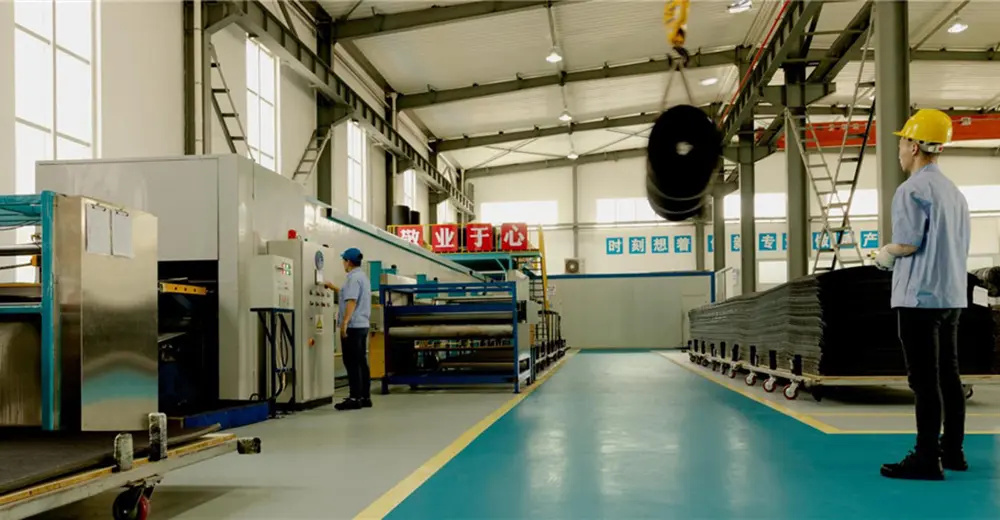
The narrative surrounding Changmei Technology’s "China’s first" manufacturing achievement is rooted in two distinct historical milestones. In 2014, the company built the only polyurethane continuous foaming mat production line in China, establishing itself as the operator of the first domestically developed polyurethane foaming production line. However, the direct manufacturing process for the Elastic Rail Pads remains precision injection molding.
Highlighting the 2014 milestone places the company’s polyurethane continuous foaming capability within a broader timeline of technological advancement, demonstrating a long-standing internal foundation for manufacturing specialized rail transit components.
At the corporate level, the annual production capacity for polyurethane foam isolation mats is reported as 1,500,000 m². This broad PU foam mat capacity represents an independent manufacturing metric that operates in parallel with the injection-molded Elastic Rail Pads. By separating these two manufacturing tracks, the company presents an accurate, non-conflated picture of its diverse production capabilities.
Model Breadth Turns Stiffness Targets into Procurement Choices
The standard product matrix for Elastic Rail Pads includes a wide array of specific models and dimensions, ensuring that static stiffness and material requirements can be immediately mapped to concrete drawing numbers and installation geometries. This moves the procurement process away from abstract material families and directly into actionable component selection.
The available models include the Polyester elastic pad Type I DTB-08, the Rail pad BJM7-SS-201-01-TR-008, and various under-rail pads. The dimensions are highly specific, featuring sizes such as 184×148×16 mm and 190×147×16 mm, designed to interface seamlessly with different rail base and baseplate configurations.
When this extensive model list is cross-referenced with the stiffness and fatigue specifications, engineering procurement teams can efficiently verify the pad dimensions, node stiffness, and fatigue performance against their line design documents before authorizing bulk production of a specific material batch.
Quality Records Connect Factory History to Current Rail-Pad Deliveries
A factory's manufacturing history only delivers true procurement value when it is backed by verifiable process control during actual product delivery. Changmei Technology's service workflow provides critical-stage inspection reports and real-time production progress tracking, ensuring that every technical specification is continuously verified during the bulk manufacturing phase.
Because production progress can be tracked in real time, procurement teams have full visibility into the manufacturing schedule. The provision of inspection reports at every critical stage allows project managers to convert the stringent D/S ratio, fatigue criteria, and dimensional tolerances into verifiable batch documentation checkpoints.
This transparent delivery mechanism perfectly complements the precise parameter matrix of the Elastic Rail Pads. While the technical parameters define the product acceptance standard, the critical-stage inspection reports guarantee full process traceability. Together, they establish a highly reliable framework for long-term project supply. For additional product specifications and engineering support, visit https://www.changmeitech.com/.
Shaanxi Changmei Technology Co., Ltd.
Changmei Technology
email us here
Visit us on social media:
LinkedIn
Facebook
YouTube
TikTok
Legal Disclaimer:
EIN Presswire provides this news content "as is" without warranty of any kind. We do not accept any responsibility or liability for the accuracy, content, images, videos, licenses, completeness, legality, or reliability of the information contained in this article. If you have any complaints or copyright issues related to this article, kindly contact the author above.
